MNE-RSA#
This is a Python package for performing representational similarity analysis (RSA) using MNE-Python data structures. The main use-case is to perform RSA using a “searchlight” approach through time and/or a volumetric or surface source space.
Read more on RSA in the paper that introduced the technique:
Nikolaus Kriegeskorte, Marieke Mur and Peter Bandettini (2008). Representational similarity analysis - connecting the branches of systems neuroscience. Frontiers in Systems Neuroscience, 2(4). https://doi.org/10.3389/neuro.06.004.2008
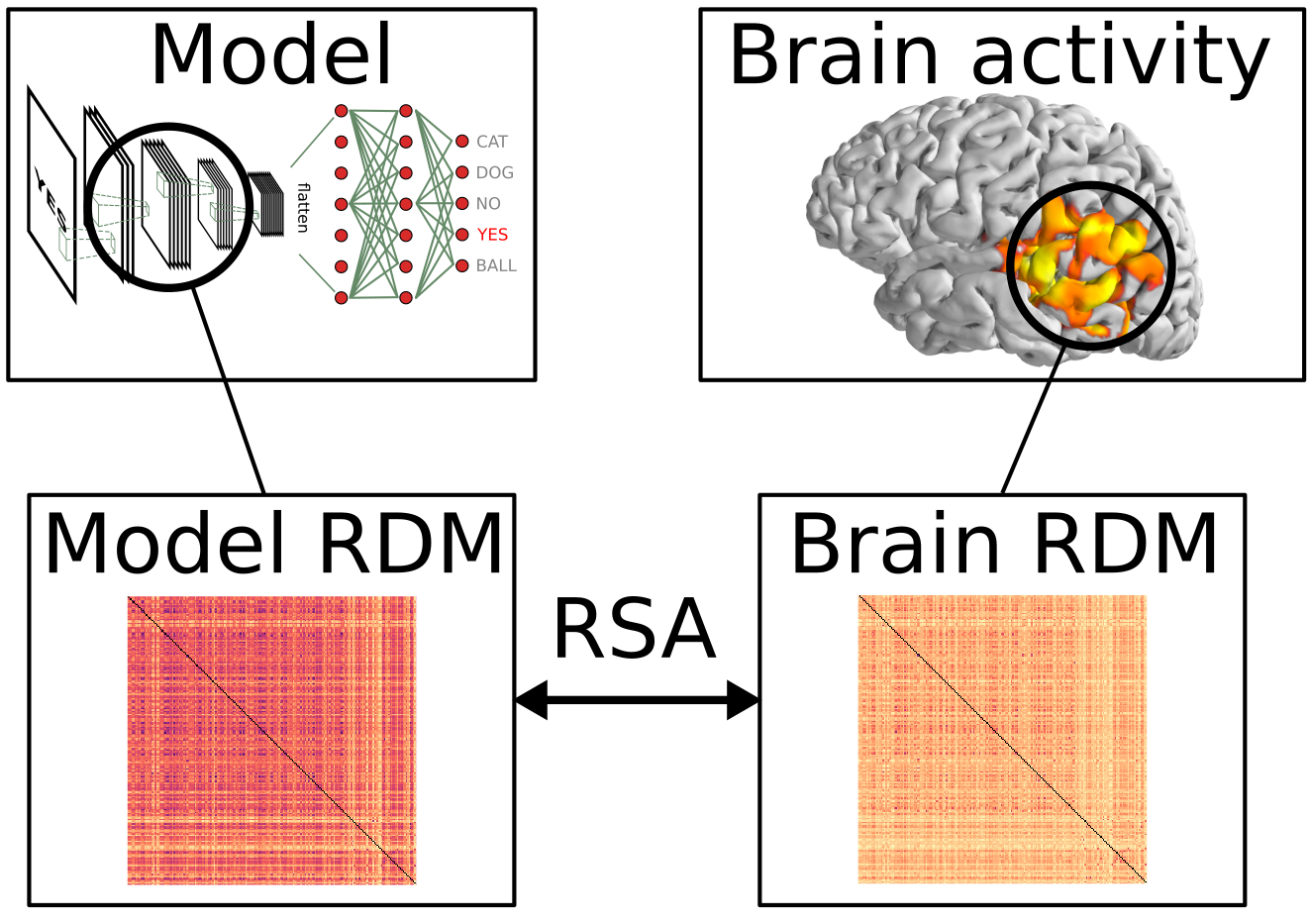
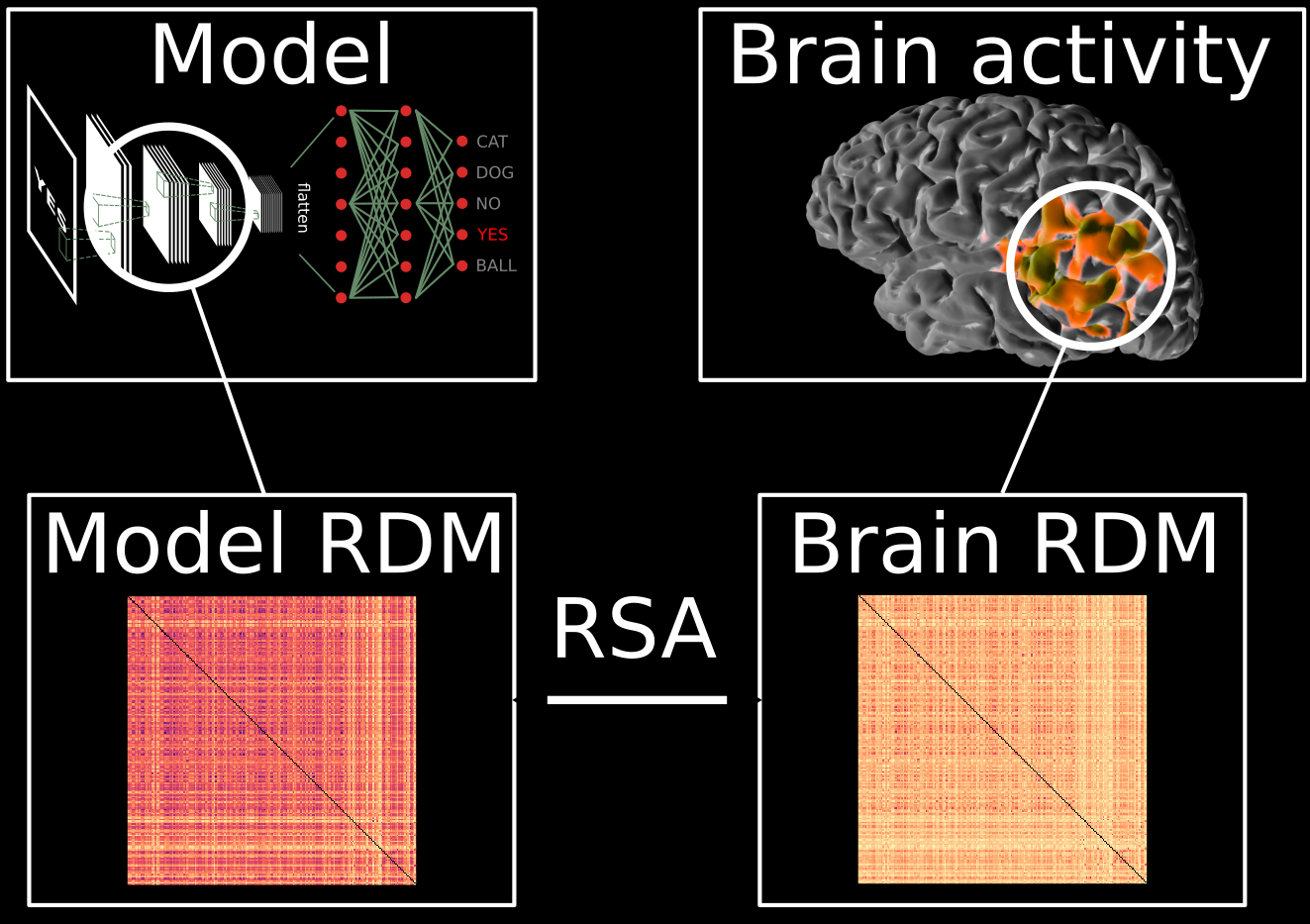
Use cases#
This is what the package can do for you:
Compute RDMs on arbitrary data
Compute RDMs in a searchlight across:
vertices/voxels and samples (source level)
sensors and samples (sensor level)
vertices/voxels only (source level)
sensors only (sensor level)
samples only (source and sensor level)
Use cross-validated distance metrics when computing RDMs
And of course: compute RSA between RDMs
Supported metrics for comparing RDMs:
Spearman correlation (the default)
Pearson correlation
Kendall’s Tau-A
Linear regression (when comparing multiple RDMs at once)
Partial correlation (when comparing multiple RDMs at once)
Installation#
The package can be installed either through PIP: pip install mne-rsa
or through conda using the conda-forge channel: conda install -c conda-forge mne-rsa
Installing through either channel will pull in MNE-Python as a dependency, along with Qt 6], PyVista and Scikit-Learn. See requirements.txt for the full list of packages.
Example usage#
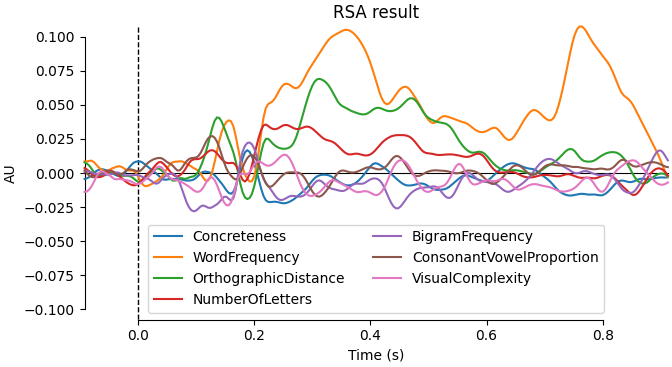
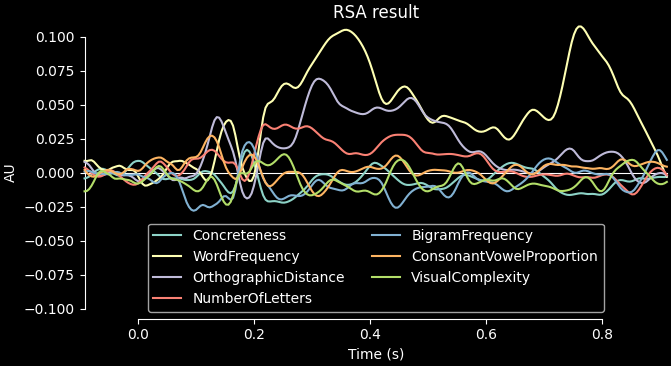
Basic example of performing RSA on the EEG “kiloword” data using a sliding window across time:
import mne
import mne_rsa
data_path = mne.datasets.kiloword.data_path(verbose=True)
epochs = mne.read_epochs(data_path / "kword_metadata-epo.fif")
# Create model RDMs based on each stimulus property
columns = epochs.metadata.columns[1:]  # Skip the first column: WORD
model_rdms = [mne_rsa.compute_rdm(epochs.metadata[col], metric="euclidean") for col in columns]
# Perform RSA in a sliding window across time
rsa_results = mne_rsa.rsa_epochs(epochs, model_rdms, temporal_radius=0.01)
# Plot the result
mne.viz.plot_compare_evokeds({column: result for column, result in zip(columns, rsa_results)},
                             picks="rsa", legend="lower center", title="RSA result")
Documentation#
For a detailed guide on RSA analysis from start to finish on an example dataset, see the Tutorials.
For quick guides on how to do specific things, see the Examples.
Finally, there is the API reference documentation.
Integration with other packages#
The main use-case for this package to perform RSA analysis on EEG and MEG data. Hence, integration functions with MNE-Python are provided. There is also some integration with nipy for fMRI that should do well in a nilearn setup.
Performance#
This package aims to be fast and memory efficient. An important design feature is that under the hood, everything operates on generators. The searchlight routines produce a generator of RDMs which are consumed by a generator of RSA values. Parallel processing is also supported, so you can use all of your CPU cores.
Support#
This free software comes without any form of official support. However, if you think you have encountered a bug or have a particularly great idea for improvements, please open an issue on Github. For questions and help with your analysis, you are welcome to post on the MNE forum.
Contributing#
Development of the package happens on Github under the umbrella of MNE-tools. Everyone is welcome to raise issues or contribute pull requests as long as they abide by our Code of Conduct. For more information about the ways in which one can contribute, see the Contributing guide of MNE-Python, which by and large applies to this project as well.
Here is how to install the additional required packages for developing MNE-RSA and set up the package in development mode:
git clone git@github.com:mne-tools/mne-rsa.git
cd mne-rsa
pip install -r requirements-dev.txt
pip install -e .
To run the test suite, execute pytest in the main mne-rsa folder.
To build the documentation, execute make html in the mne-rsa/doc folder (or on
Windows: sphinx-build . _build/html).
Citation#
If you end up using this package for the data analysis that is part of a scientific article, please cite:
Marijn van Vliet, Stefan Appelhoff, Takao Shimizu, Egor Eremin, Annika Hultén, Yuanfang Zhao, and Richard Höchenberger, (2025). MNE-RSA: Representational Similarity Analysis on EEG, MEG and fMRI data. Journal of Open Source Software, 10(116), 9148, https://doi.org/10.21105/joss.09148