Note
Go to the end to download the full example code or to run this example in your browser via Binder.
Signal Enhancement Techniques#
In this document we investigate the effect of different signal enhancement techniques on functional near-infrared spectroscopy (fNIRS) data.
# Authors: Robert Luke <mail@robertluke.net>
#
# License: BSD (3-clause)

import os

import matplotlib.pyplot as plt
import mne

import mne_nirs
from mne_nirs.channels import picks_pair_to_idx
Import and preprocess data#
This code is exactly the same as the first sections in the MNE tutorial. See https://mne.tools/dev/auto_tutorials/preprocessing/plot_70_fnirs_processing.html for more details.
fnirs_data_folder = mne.datasets.fnirs_motor.data_path()
fnirs_raw_dir = os.path.join(fnirs_data_folder, "Participant-1")
raw_intensity = mne.io.read_raw_nirx(fnirs_raw_dir, verbose=True).load_data()
raw_od = mne.preprocessing.nirs.optical_density(raw_intensity)
raw_haemo = mne.preprocessing.nirs.beer_lambert_law(raw_od, ppf=0.1)
raw_haemo = mne_nirs.channels.get_long_channels(raw_haemo)

raw_haemo = raw_haemo.filter(0.05, 0.7, h_trans_bandwidth=0.2, l_trans_bandwidth=0.02)
events, _ = mne.events_from_annotations(
    raw_haemo, event_id={"1.0": 1, "2.0": 2, "3.0": 3}
)
event_dict = {"Control": 1, "Tapping/Left": 2, "Tapping/Right": 3}
Loading /home/circleci/mne_data/MNE-fNIRS-motor-data/Participant-1
Reading 0 ... 23238  =      0.000 ...  2974.464 secs...
Filtering raw data in 1 contiguous segment
Setting up band-pass filter from 0.05 - 0.7 Hz

FIR filter parameters
---------------------
Designing a one-pass, zero-phase, non-causal bandpass filter:
- Windowed time-domain design (firwin) method
- Hamming window with 0.0194 passband ripple and 53 dB stopband attenuation
- Lower passband edge: 0.05
- Lower transition bandwidth: 0.02 Hz (-6 dB cutoff frequency: 0.04 Hz)
- Upper passband edge: 0.70 Hz
- Upper transition bandwidth: 0.20 Hz (-6 dB cutoff frequency: 0.80 Hz)
- Filter length: 1291 samples (165.248 s)

Used Annotations descriptions: ['1.0', '2.0', '3.0']
Extract epochs with no additional processing#
First we extract the epochs with no additional processing, this result should be the same as the MNE tutorial.
reject_criteria = dict(hbo=100e-6)
tmin, tmax = -5, 15

epochs = mne.Epochs(
    raw_haemo,
    events,
    event_id=event_dict,
    tmin=tmin,
    tmax=tmax,
    reject=reject_criteria,
    reject_by_annotation=True,
    proj=True,
    baseline=(None, 0),
    preload=True,
    detrend=None,
    verbose=True,
)

evoked_dict = {
    "Tapping/HbO": epochs["Tapping"].average(picks="hbo"),
    "Tapping/HbR": epochs["Tapping"].average(picks="hbr"),
    "Control/HbO": epochs["Control"].average(picks="hbo"),
    "Control/HbR": epochs["Control"].average(picks="hbr"),
}

# Rename channels until the encoding of frequency in ch_name is fixed
for condition in evoked_dict:
    evoked_dict[condition].rename_channels(lambda x: x[:-4])
Not setting metadata
90 matching events found
Setting baseline interval to [-4.992, 0.0] s
Applying baseline correction (mode: mean)
0 projection items activated
Using data from preloaded Raw for 90 events and 157 original time points ...
    Rejecting  epoch based on HBO : ['S4_D4 hbo']
    Rejecting  epoch based on HBO : ['S4_D4 hbo']
    Rejecting  epoch based on HBO : ['S4_D4 hbo', 'S8_D8 hbo']
    Rejecting  epoch based on HBO : ['S8_D8 hbo']
    Rejecting  epoch based on HBO : ['S4_D4 hbo']
5 bad epochs dropped
Apply negative correlation enhancement algorithm#
Apply Cui et. al. 2010 and extract epochs.
raw_anti = mne_nirs.signal_enhancement.enhance_negative_correlation(raw_haemo)

epochs_anti = mne.Epochs(
    raw_anti,
    events,
    event_id=event_dict,
    tmin=tmin,
    tmax=tmax,
    reject=reject_criteria,
    reject_by_annotation=True,
    proj=True,
    baseline=(None, 0),
    preload=True,
    detrend=None,
    verbose=True,
)

evoked_dict_anti = {
    "Tapping/HbO": epochs_anti["Tapping"].average(picks="hbo"),
    "Tapping/HbR": epochs_anti["Tapping"].average(picks="hbr"),
    "Control/HbO": epochs_anti["Control"].average(picks="hbo"),
    "Control/HbR": epochs_anti["Control"].average(picks="hbr"),
}

# Rename channels until the encoding of frequency in ch_name is fixed
for condition in evoked_dict_anti:
    evoked_dict_anti[condition].rename_channels(lambda x: x[:-4])
Not setting metadata
90 matching events found
Setting baseline interval to [-4.992, 0.0] s
Applying baseline correction (mode: mean)
0 projection items activated
Using data from preloaded Raw for 90 events and 157 original time points ...
0 bad epochs dropped
Apply short channel correction#
Apply Scholkmann et al 2014 and extract epochs.
od_corrected = mne_nirs.signal_enhancement.short_channel_regression(raw_od)
raw_haemo = mne.preprocessing.nirs.beer_lambert_law(od_corrected, ppf=0.1)
raw_haemo = mne_nirs.channels.get_long_channels(raw_haemo)

raw_haemo = raw_haemo.filter(0.05, 0.7, h_trans_bandwidth=0.2, l_trans_bandwidth=0.02)

epochs_corr = mne.Epochs(
    raw_haemo,
    events,
    event_id=event_dict,
    tmin=tmin,
    tmax=tmax,
    reject=reject_criteria,
    reject_by_annotation=True,
    proj=True,
    baseline=(None, 0),
    preload=True,
    detrend=None,
    verbose=True,
)

evoked_dict_corr = {
    "Tapping/HbO": epochs_corr["Tapping"].average(picks="hbo"),
    "Tapping/HbR": epochs_corr["Tapping"].average(picks="hbr"),
    "Control/HbO": epochs_corr["Control"].average(picks="hbo"),
    "Control/HbR": epochs_corr["Control"].average(picks="hbr"),
}

# Rename channels until the encoding of frequency in ch_name is fixed
for condition in evoked_dict_corr:
    evoked_dict_corr[condition].rename_channels(lambda x: x[:-4])
Filtering raw data in 1 contiguous segment
Setting up band-pass filter from 0.05 - 0.7 Hz

FIR filter parameters
---------------------
Designing a one-pass, zero-phase, non-causal bandpass filter:
- Windowed time-domain design (firwin) method
- Hamming window with 0.0194 passband ripple and 53 dB stopband attenuation
- Lower passband edge: 0.05
- Lower transition bandwidth: 0.02 Hz (-6 dB cutoff frequency: 0.04 Hz)
- Upper passband edge: 0.70 Hz
- Upper transition bandwidth: 0.20 Hz (-6 dB cutoff frequency: 0.80 Hz)
- Filter length: 1291 samples (165.248 s)

Not setting metadata
90 matching events found
Setting baseline interval to [-4.992, 0.0] s
Applying baseline correction (mode: mean)
0 projection items activated
Using data from preloaded Raw for 90 events and 157 original time points ...
    Rejecting  epoch based on HBO : ['S4_D4 hbo', 'S8_D8 hbo']
    Rejecting  epoch based on HBO : ['S1_D1 hbo', 'S7_D6 hbo', 'S7_D7 hbo', 'S8_D8 hbo']
    Rejecting  epoch based on HBO : ['S4_D4 hbo', 'S8_D8 hbo']
3 bad epochs dropped
Plot approaches for comparison#
Plot the average epochs with and without Cui 2010 applied.
fig, axes = plt.subplots(nrows=1, ncols=3, figsize=(15, 6))

color_dict = dict(HbO="#AA3377", HbR="b")
styles_dict = dict(Control=dict(linestyle="dashed"))

mne.viz.plot_compare_evokeds(
    evoked_dict,
    combine="mean",
    ci=0.95,
    axes=axes[0],
    colors=color_dict,
    styles=styles_dict,
    ylim=dict(hbo=[-10, 15]),
)

mne.viz.plot_compare_evokeds(
    evoked_dict_anti,
    combine="mean",
    ci=0.95,
    axes=axes[1],
    colors=color_dict,
    styles=styles_dict,
    ylim=dict(hbo=[-10, 15]),
)

mne.viz.plot_compare_evokeds(
    evoked_dict_corr,
    combine="mean",
    ci=0.95,
    axes=axes[2],
    colors=color_dict,
    styles=styles_dict,
    ylim=dict(hbo=[-10, 15]),
)

for column, condition in enumerate(
    ["Original Data", "With Enhanced Anticorrelation", "With Short Regression"]
):
    axes[column].set_title(f"{condition}")
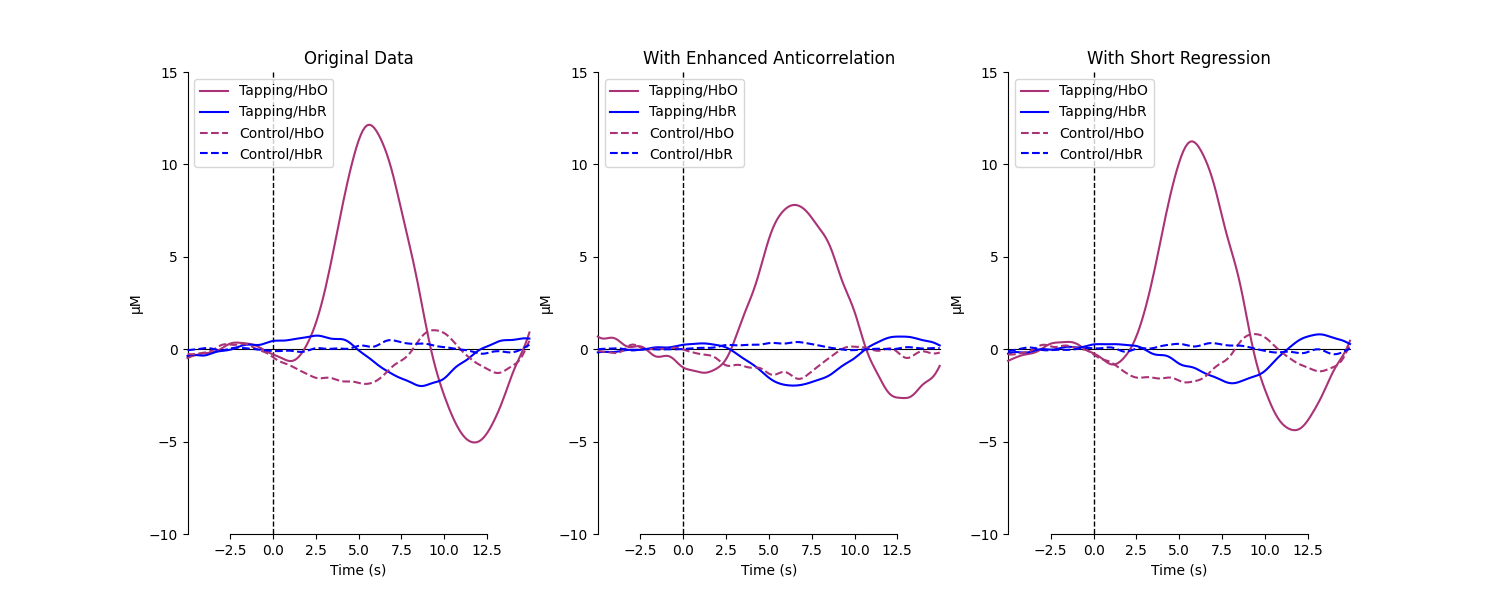
combining channels using "mean"
combining channels using "mean"
combining channels using "mean"
combining channels using "mean"
combining channels using "mean"
combining channels using "mean"
combining channels using "mean"
combining channels using "mean"
combining channels using "mean"
combining channels using "mean"
combining channels using "mean"
combining channels using "mean"
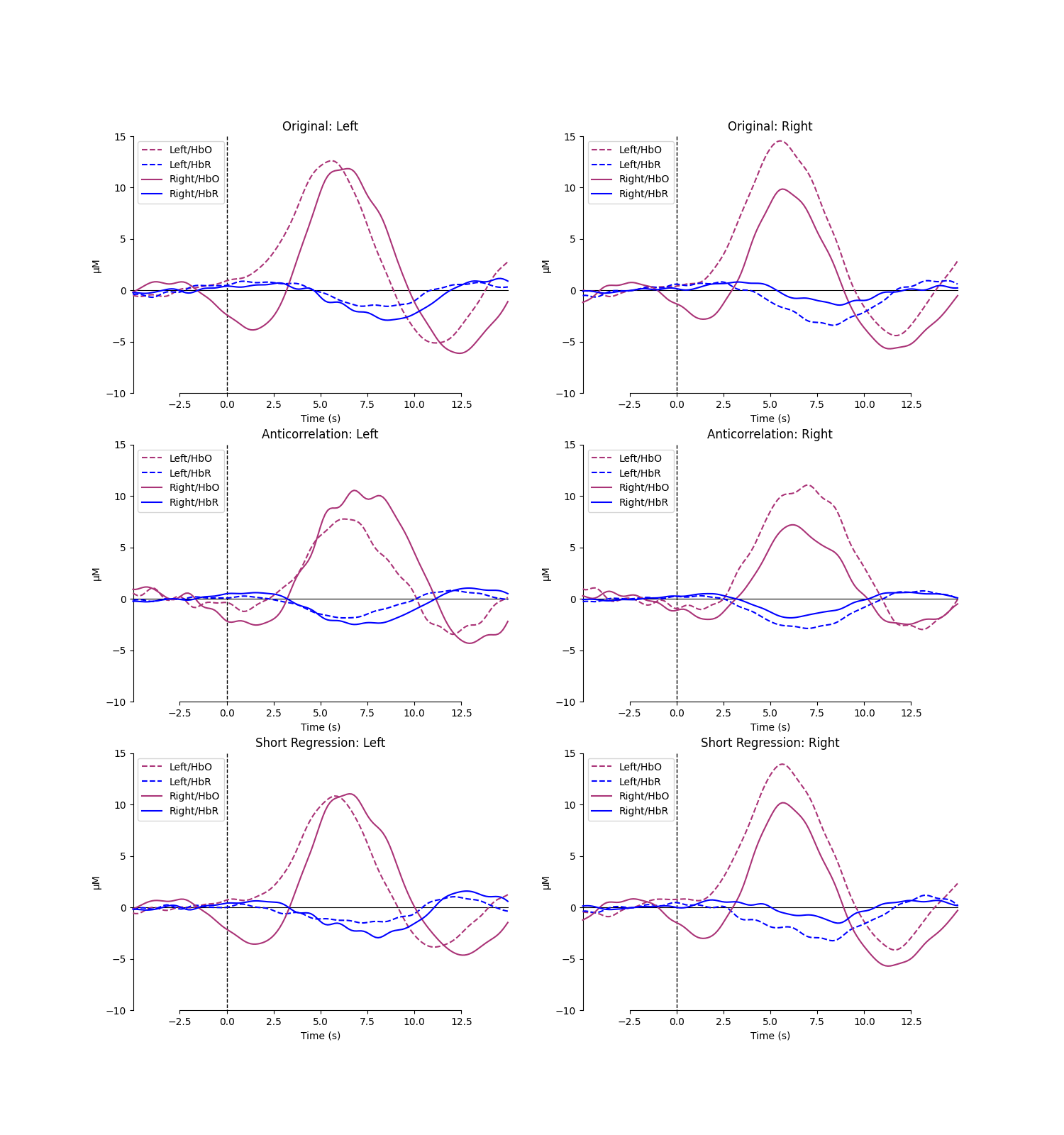
Plot hemisphere for each approach#
Plot the epoch image for each approach. First we specify the source detector pairs for analysis.
left = [[1, 3], [2, 3], [1, 2], [4, 3]]
right = [[5, 7], [6, 7], [5, 6], [8, 7]]

groups = dict(
    Left_ROI=picks_pair_to_idx(raw_anti.pick(picks="hbo"), left, on_missing="warning"),
    Right_ROI=picks_pair_to_idx(
        raw_anti.pick(picks="hbo"), right, on_missing="warning"
    ),
)

evoked_dict = {
    "Left/HbO": epochs["Tapping/Left"].average(picks="hbo"),
    "Left/HbR": epochs["Tapping/Left"].average(picks="hbr"),
    "Right/HbO": epochs["Tapping/Right"].average(picks="hbo"),
    "Right/HbR": epochs["Tapping/Right"].average(picks="hbr"),
}
for condition in evoked_dict:
    evoked_dict[condition].rename_channels(lambda x: x[:-4])

evoked_dict_anti = {
    "Left/HbO": epochs_anti["Tapping/Left"].average(picks="hbo"),
    "Left/HbR": epochs_anti["Tapping/Left"].average(picks="hbr"),
    "Right/HbO": epochs_anti["Tapping/Right"].average(picks="hbo"),
    "Right/HbR": epochs_anti["Tapping/Right"].average(picks="hbr"),
}
for condition in evoked_dict_anti:
    evoked_dict_anti[condition].rename_channels(lambda x: x[:-4])

evoked_dict_corr = {
    "Left/HbO": epochs_corr["Tapping/Left"].average(picks="hbo"),
    "Left/HbR": epochs_corr["Tapping/Left"].average(picks="hbr"),
    "Right/HbO": epochs_corr["Tapping/Right"].average(picks="hbo"),
    "Right/HbR": epochs_corr["Tapping/Right"].average(picks="hbr"),
}
for condition in evoked_dict_corr:
    evoked_dict_corr[condition].rename_channels(lambda x: x[:-4])


color_dict = dict(HbO="#AA3377", HbR="b")
styles_dict = dict(Left=dict(linestyle="dashed"))

fig, axes = plt.subplots(nrows=3, ncols=2, figsize=(15, 16))

mne.viz.plot_compare_evokeds(
    evoked_dict,
    combine="mean",
    ci=0.95,
    picks=groups["Left_ROI"],
    axes=axes[0, 0],
    colors=color_dict,
    styles=styles_dict,
    ylim=dict(hbo=[-10, 15]),
)

mne.viz.plot_compare_evokeds(
    evoked_dict,
    combine="mean",
    ci=0.95,
    picks=groups["Right_ROI"],
    axes=axes[0, 1],
    colors=color_dict,
    styles=styles_dict,
    ylim=dict(hbo=[-10, 15]),
)

mne.viz.plot_compare_evokeds(
    evoked_dict_anti,
    combine="mean",
    ci=0.95,
    picks=groups["Left_ROI"],
    axes=axes[1, 0],
    colors=color_dict,
    styles=styles_dict,
    ylim=dict(hbo=[-10, 15]),
)

mne.viz.plot_compare_evokeds(
    evoked_dict_anti,
    combine="mean",
    ci=0.95,
    picks=groups["Right_ROI"],
    axes=axes[1, 1],
    colors=color_dict,
    styles=styles_dict,
    ylim=dict(hbo=[-10, 15]),
)

mne.viz.plot_compare_evokeds(
    evoked_dict_corr,
    combine="mean",
    ci=0.95,
    picks=groups["Left_ROI"],
    axes=axes[2, 0],
    colors=color_dict,
    styles=styles_dict,
    ylim=dict(hbo=[-10, 15]),
)

mne.viz.plot_compare_evokeds(
    evoked_dict_corr,
    combine="mean",
    ci=0.95,
    picks=groups["Right_ROI"],
    axes=axes[2, 1],
    colors=color_dict,
    styles=styles_dict,
    ylim=dict(hbo=[-10, 15]),
)

for row, condition in enumerate(["Original", "Anticorrelation", "Short Regression"]):
    for column, hemi in enumerate(["Left", "Right"]):
        axes[row, column].set_title(f"{condition}: {hemi}")
combining channels using "mean"
combining channels using "mean"
combining channels using "mean"
combining channels using "mean"
combining channels using "mean"
combining channels using "mean"
combining channels using "mean"
combining channels using "mean"
combining channels using "mean"
combining channels using "mean"
combining channels using "mean"
combining channels using "mean"
combining channels using "mean"
combining channels using "mean"
combining channels using "mean"
combining channels using "mean"
combining channels using "mean"
combining channels using "mean"
combining channels using "mean"
combining channels using "mean"
combining channels using "mean"
combining channels using "mean"
combining channels using "mean"
combining channels using "mean"
Total running time of the script: (0 minutes 1.045 seconds)
