mne_connectivity.vector_auto_regression#
- mne_connectivity.vector_auto_regression(data, times=None, names=None, lags=1, l2_reg=0.0, compute_fb_operator=False, model='dynamic', n_jobs=1, verbose=None)[source]#
Compute vector auto-regressive (VAR) model.
- Parameters:
- dataarray_like, shape (n_epochs, n_signals, n_times) |
Epochs| generator The data from which to compute connectivity. The epochs dimension is interpreted differently, depending on the
'model'argument.- timesarray_like |
None The time points used to construct the epoched
data. IfNone, thentimes_usedin the returnedconnwill not be available.- namesarray_like |
None The names of the nodes of the dataset used to compute connectivity. If
None(default), then names will be a list of integers from 0 ton_nodes. If a list of names, then it must be equal in length ton_nodes.- lags
int|None Autoregressive model order (default 1). See
select_order()for a selection based on information criterion.- l2_reg
float|None Ridge penalty (l2-regularization) parameter (default 0.0).
- compute_fb_operatorbool
Whether to compute the backwards operator and average with the forward operator. Addresses bias in the least-square estimation [1].
- model
'dynamic'|'avg-epochs' Whether to compute one VAR model using all epochs as multiple samples of the same VAR model (
'avg-epochs'), or to compute a separate VAR model for each epoch ('dynamic', default), which results in a time-varying VAR model. See Notes.- n_jobs
int The number of jobs to run in parallel (default 1). Requires the joblib package.
- verbosebool |
str|int|None If not
None, override default verbose level (seemne.verbose()for more info). If used, it should be passed as a keyword-argument only.
- dataarray_like, shape (n_epochs, n_signals, n_times) |
- Returns:
- conn
VARConnectivity|EpochVARConnectivity The connectivity data estimated.
- conn
See also
Notes
Names can be passed in, which are then used to instantiate the nodes of the connectivity class. For example, they can be the electrode names of EEG.
For higher-order VAR models, there are
n_orderAmatrices, representing the linear dynamics with respect to that lag.When computing a VAR model (i.e. linear dynamical system), we require the input to be a
(n_epochs, n_signals, n_times)3D array. There are two ways one can interpret the data in the model.First, epochs can be treated as multiple samples observed for a single VAR model. That is, we have \(X_1, X_2, ..., X_n\), where each \(X_i\) is a
(n_signals, n_times)data array, withn_epochs. We are interested in estimating the parameters, \((A_1, A_2, ..., A_{order})\), from the following model over all epochs:\[X(t+1) = \sum_{i=0}^{order} A_i X(t-i)\]This results in one VAR model over all the epochs.
The second approach treats each epoch as a different VAR model, estimating a time-varying VAR model. Using the same data as above, we now are interested in estimating the parameters, \((A_1, A_2, ..., A_{order})\) for each epoch. The model would be the following for each epoch:
\[X(t+1) = \sum_{i=0}^{order} A_i X(t-i)\]This results in one VAR model for each epoch. This is done according to the model in [2].
In order to optimize RAM usage, the estimating equations are set up by iterating over sample points. This assumes that there are in general more sample points than channels. You should not estimate a VAR model using less sample points than channels, unless you have good reason.
References
Examples using mne_connectivity.vector_auto_regression#
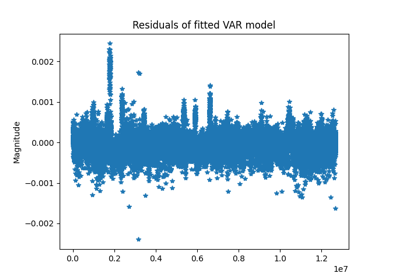
Compute vector autoregressive model (linear system)