
DSS#
These examples show four scientifically distinct ways to define structure of interest with Denoising Source Separation.
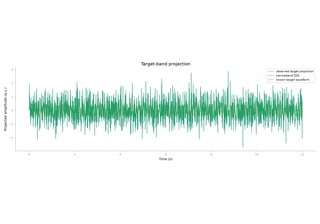
The evoked example uses trial reproducibility on real held-out somatosensory MEG data. The cardiac example combines real Sample EEG and real R-peak timing with a controlled planted cardiac artifact, then uses an independent clean-input preservation control. The narrowband example uses controlled spectral structure to recover a known target source. The TimeShiftDSS example extends reproducibility into lag-augmented spatiotemporal space and uses held-out and surrogate validation.
A DSS bias defines what the decomposition emphasizes; it does not by itself establish that a selected component is neural signal or artifact.
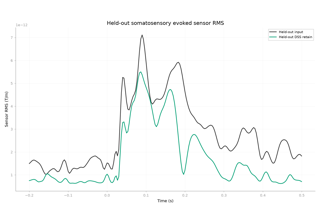
Enhancing a reproducible somatosensory response with DSS
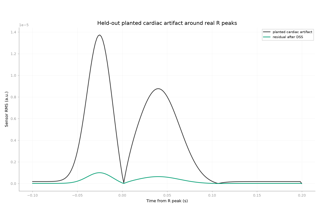
Removing a planted cardiac-locked artifact with DSS
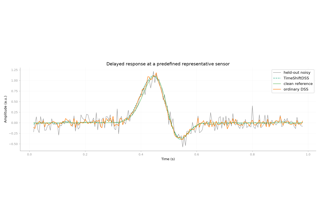
Recovering delayed reproducible structure with TimeShiftDSS