Note
Go to the end to download the full example code.
ZapLine on MEG-like data with many co-equal noise components.#
This example demonstrates the auto-mode fix from Issue #34. With
high-channel-count MEG recordings (e.g., CTF 275-magnetometer systems),
line noise couples into many sensors through different lead-field paths,
producing several co-equal strong DSS components. The classic
iterative_outlier_removal selector underdetects in this regime
because no single eigenvalue stands out from the others; the new
auto_select_components_robust falls back to a log-space knee detector
that catches the cluster boundary.
The example uses synthetic data because the issue does not provide a public dataset, but the eigenvalue pattern reproduced here mirrors the one reported in mne-tools/mne-denoise#34.
Authors: Sina Esmaeili (sina.esmaeili@umontreal.ca)
Imports#
import matplotlib.pyplot as plt
import numpy as np
from scipy import signal

from mne_denoise.dss.utils.selection import (
    auto_select_components_robust,
    detect_eigenvalue_knee,
    iterative_outlier_removal,
)
from mne_denoise.viz import plot_component_score_curve, plot_psd_comparison
from mne_denoise.zapline import ZapLine
Simulate a MEG-like recording#
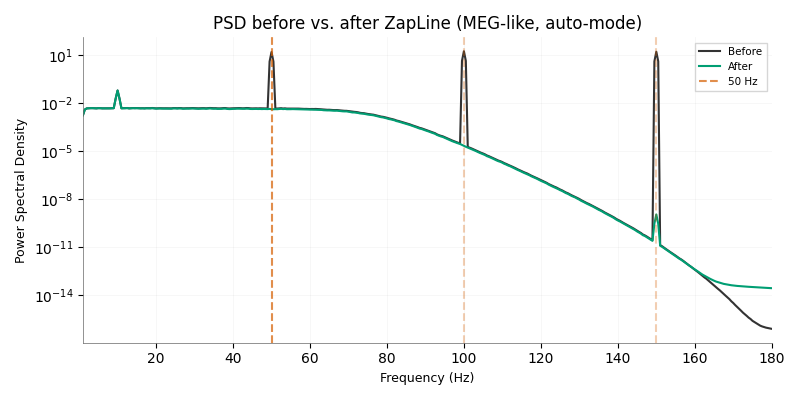
Three harmonics (50, 100, 150 Hz) couple into each of 64 channels with an independent phase and amplitude. This is a deliberately simple stand-in for the spatially heterogeneous line-noise pickup seen in real MEG.
rng = np.random.default_rng(34)
sfreq = 400
n_channels = 64
n_times = sfreq * 60  # 60 s
times = np.arange(n_times) / sfreq

line = np.zeros((n_channels, n_times))
for freq in (50.0, 100.0, 150.0):
    phases = rng.uniform(0, 2 * np.pi, n_channels)
    amps = rng.normal(1.0, 0.3, n_channels) * 5.0
    line += amps[:, None] * np.sin(2 * np.pi * freq * times[None, :] + phases[:, None])

# 1/f-ish brain background
background = rng.normal(0, 1, (n_channels, n_times))
sos = signal.butter(4, [1, 80], btype="bandpass", fs=sfreq, output="sos")
background = signal.sosfiltfilt(sos, background, axis=-1)
# Add a small 10 Hz alpha rhythm that we want to preserve
alpha = 0.3 * np.sin(2 * np.pi * 10.0 * times)
background += alpha[None, :]

data = background + line
Fit ZapLine in auto mode#
Inspect what each selection strategy returns#
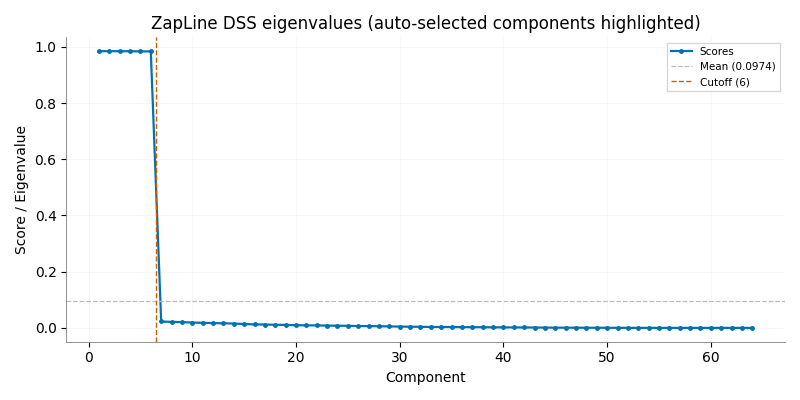
Before the fix, ZapLine called iterative_outlier_removal directly.
On the user’s CTF data it returned 0 even though seven DSS eigenvalues
clearly stood above the noise floor. The new auto_select_components_robust
additionally runs detect_eigenvalue_knee and uses the larger of the two
counts.
eigs = zap.eigenvalues_
n_outlier = iterative_outlier_removal(eigs, sigma=zap.threshold)
n_knee = detect_eigenvalue_knee(
    eigs, rel_floor=zap.knee_rel_floor, min_ratio=zap.knee_min_ratio
)
n_robust = auto_select_components_robust(
    eigs,
    sigma=zap.threshold,
    knee_rel_floor=zap.knee_rel_floor,
    knee_min_ratio=zap.knee_min_ratio,
)

print(f"iterative_outlier_removal -> {n_outlier}")
print(f"detect_eigenvalue_knee    -> {n_knee}")
print(f"auto_select_components_robust -> {n_robust}")
print(f"ZapLine n_removed_        -> {zap.n_removed_}")
iterative_outlier_removal -> 6
detect_eigenvalue_knee    -> 6
auto_select_components_robust -> 6
ZapLine n_removed_        -> 6
Visualize the eigenvalue spectrum#
The knee marks the boundary between the line-noise cluster and the background floor.
fig, ax = plt.subplots(figsize=(8, 4))
plot_component_score_curve(zap, ax=ax, show=False)
ax.set_title("ZapLine DSS eigenvalues (auto-selected components highlighted)")
plt.tight_layout()
plt.show()
Confirm the cleaning worked#
fig, ax = plt.subplots(figsize=(8, 4))
plot_psd_comparison(
    data,
    cleaned,
    sfreq=sfreq,
    line_freq=50.0,
    fmin=1,
    fmax=180,
    ax=ax,
    show=False,
)
ax.set_title("PSD before vs. after ZapLine (MEG-like, auto-mode)")
plt.tight_layout()
plt.show()
Workarounds for the rank-loss warning#
Real CTF recordings can trip the rank-loss warning in
mne_denoise.dss.linear.compute_dss() when channels with very different
physical units are fit together, or when the baseline covariance spectrum spans
many decades. Three options:
Pass
normalize_input=Truetomne_denoise.dss.linear.DSSwhen fitting DSS directly (ZapLine sets this toFalseby design).Lower
regif the relative cutoff discards too many PCA dimensions.Fit homogeneous channel types separately, e.g. use
raw.copy().pick("mag")for CTF magnetometers instead of passing all channels at once.
Total running time of the script: (0 minutes 0.564 seconds)