Note
Go to the end to download the full example code.
Guided ASR: preserving neural activity that ASR would over-clean.#
Standard ASR decides purely on variance, so a strong, spatially structured
neural burst (here a transient 10 Hz oscillation) looks just as “abnormal”
as an artifact and gets reconstructed away. GuidedASR keeps ASR’s
abnormality detection but adds DSS-style bias operators that recognise the
neural direction and a continuous reconstruction weight that rescues it, while
still removing a genuine artifact.
This example builds a substrate with a known 10 Hz neural target and a known broadband artifact, cleans it with standard ASR and with GuidedASR, and shows that GuidedASR preserves the neural projection that standard ASR removes.
Warning
GuidedASR is an unpublished, unvalidated experimental research prototype. This synthetic demonstration is not evidence of validity on real EEG. Check neural-signal preservation, artifact attenuation, and downstream endpoints independently before scientific use.
Imports#
import matplotlib.pyplot as plt
import numpy as np

from mne_denoise.asr import ASR, GuidedASR
from mne_denoise.dss.denoisers import BandpassBias, PeakFilterBias
from mne_denoise.viz import plot_guided_asr_weights
Synthetic substrate#
A quiet 1/f-ish background (the calibration baseline), plus a transient 10 Hz neural target (fixed spatial pattern, second half) we want to PRESERVE, plus a high-amplitude broadband artifact (different pattern) we want to REMOVE.
sfreq = 250.0
rng = np.random.default_rng(7)
n_ch, n = 16, 15000
t = np.arange(n) / sfreq

background = 0.15 * rng.standard_normal((n_ch, n))
for f in (3.0, 6.0, 11.0, 23.0):
    for c in range(n_ch):
        background[c] += (1.0 / f) * np.sin(2 * np.pi * f * t + rng.uniform(0, 6.28))

p_neural = rng.standard_normal(n_ch)
p_neural /= np.linalg.norm(p_neural)
neural_ts = np.zeros(n)
neural_ts[n // 2 :] = 4.0 * np.sin(2 * np.pi * 10.0 * t[n // 2 :])
clean = background + np.outer(p_neural, neural_ts)  # ground truth

p_art = rng.standard_normal(n_ch)
p_art /= np.linalg.norm(p_art)
artifact = np.zeros((n_ch, n))
for start in (int(0.15 * n), int(0.30 * n)):
    seg = slice(start, start + int(0.4 * sfreq))
    artifact[:, seg] += 7.0 * np.outer(p_art, rng.standard_normal(seg.stop - seg.start))

contaminated = clean + artifact
calib = background[:, : int(8.0 * sfreq)]  # quiet baseline (no events, no artifact)
Clean with standard ASR and with Guided ASR#
Both calibrate on the quiet baseline. GuidedASR is told the brain subspace (a 10 Hz peak filter) and the artifact subspace (a broadband band).
common = {
    "sfreq": sfreq,
    "cutoff": 8.0,
    "calibration": "manual",
    "picks": None,
    "verbose": False,
}

asr = ASR(method="riemannian_windowed", **common).fit(calib)
cleaned_asr = np.asarray(asr.transform(contaminated))

guided = GuidedASR(
    reconstruction="soft",
    experimental=True,
    guidance_strength=1.0,
    preserve_biases=[PeakFilterBias(10.0, sfreq)],
    artifact_biases=[BandpassBias((30.0, 80.0), sfreq)],
    **common,
).fit(contaminated, calibration=calib)
cleaned_guided = np.asarray(guided.transform(contaminated))
Soft weights#
Green = kept (w -> 1), red = suppressed (w -> 0). Standard ASR would show only 0/1; the graded values are where Guided ASR preserves structure.
plot_guided_asr_weights(guided, show=False)
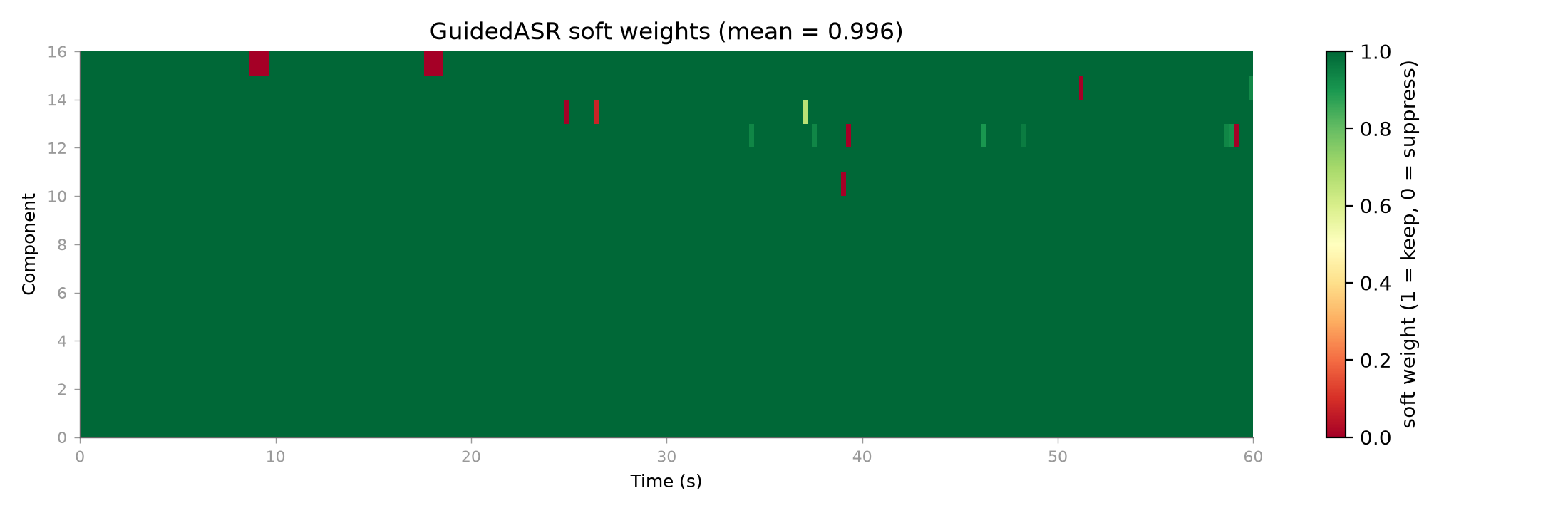
(<Figure size 2200x720 with 2 Axes>, <Axes: title={'center': 'GuidedASR soft weights (mean = 0.996)'}, xlabel='Time (s)', ylabel='Component'>)
Neural projection: preserved vs over-cleaned#
Project each signal onto the neural spatial pattern over the event region.
ev = slice(n // 2, n)
proj_clean = (p_neural @ clean)[ev]
proj_asr = (p_neural @ cleaned_asr)[ev]
proj_guided = (p_neural @ cleaned_guided)[ev]
tt = t[ev]

fig, ax = plt.subplots(figsize=(11, 3.6))
ax.plot(tt, proj_clean, color="0.6", lw=1.4, label="ground truth (neural)")
ax.plot(tt, proj_asr, color="C3", lw=0.9, alpha=0.8, label="standard ASR (removed)")
ax.plot(tt, proj_guided, color="C0", lw=1.0, label="GuidedASR (preserved)")
ax.set_xlabel("Time (s)")
ax.set_ylabel("Neural-pattern projection")
ax.set_title("GuidedASR preserves the 10 Hz neural target ASR over-cleans")
ax.legend(loc="upper right", fontsize=8)
fig.tight_layout()


def _corr(a, b):
    return float(np.corrcoef(a, b)[0, 1])


print(f"neural preservation  standard ASR: {_corr(proj_asr, proj_clean):+.3f}")
print(f"neural preservation  GuidedASR   : {_corr(proj_guided, proj_clean):+.3f}")

plt.show()
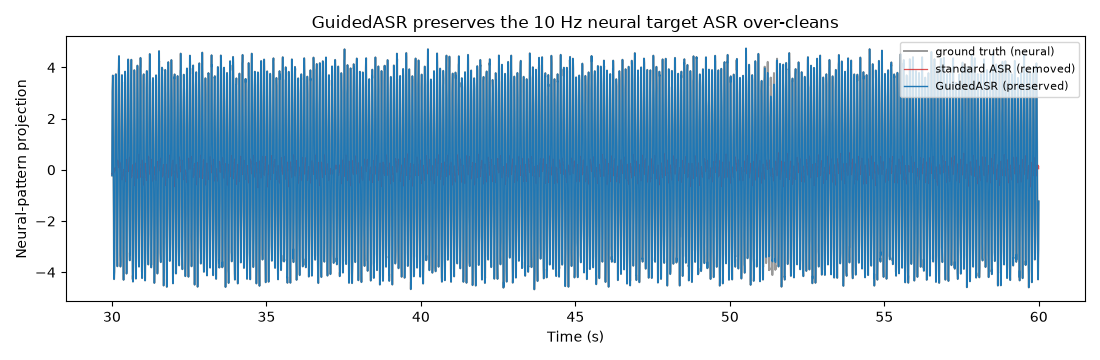
neural preservation  standard ASR: -0.734
neural preservation  GuidedASR   : +1.000
Total running time of the script: (0 minutes 1.505 seconds)